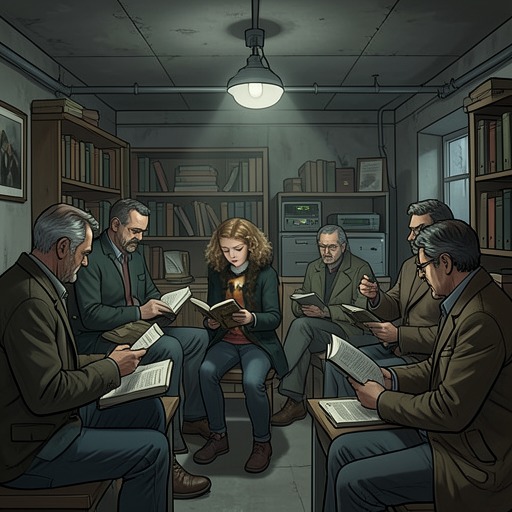
The Fiedlers’ basement air-raid shelter
The Book ThiefThe Fiedlers’ basement air-raid shelter is the wartime refuge shared by residents of Himmel Street when air raids threaten Molching. It is more than a protective room: its cramped darkness gathers neighbors, exposes the tension between private fear and public composure, and becomes the setting in which Liesel’s reading gives a frightened crowd a brief alternative to listening for bombs.
Setting and Structure
The shelter belongs to the Fiedler family, who live six houses from the Hubermann home. It is valued because it is a deep basement, large enough to receive a neighborhood community rather than merely one household. During one raid, twenty-two people crowd inside: the four Fiedlers, the Steiner family, Frau Holtzapfel, Pfiffikus, a young man, and the Jenson family. The arrangement is practical but not entirely peaceful; Rosa Hubermann and Frau Holtzapfel are kept apart to prevent their familiar quarrels from worsening the atmosphere, although the danger outside makes ordinary resentments seem secondary.
The room itself offers little comfort. A single light globe hangs from the ceiling, the air is dank and cold, and jagged walls jut outward into the bodies of people standing and talking. Sirens reach the basement in muffled, distorted form. Their sound is frightening because it carries the raid into the shelter, yet it also supplies a measurable structure to fear: the residents listen for the three sirens that will announce the end of the attack and their return to safety. The shelter therefore protects them from the immediate violence above while remaining acoustically open to it.
The Shelter Under Threat
The basement becomes necessary because the war repeatedly interrupts the apparent normality of Himmel Street. On the night of September 19, a radio warning identifies Molching as a possible target. Once again, residents stream from their houses carrying what matters most to them. Liesel carries her books between her arm and ribs, while Frau Holtzapfel struggles with a suitcase that she calls the necessities. Hans Hubermann, who has even forgotten his accordion in the rush, returns to help her, showing how evacuation turns the street into a procession of possessions, bodies, and competing priorities.
The shelter also reveals the psychological burden of hiding Max Vandenburg. When Max arrives at 33 Himmel Street in November 1940, the household must contain fear, disbelief, and paranoia without allowing them to become hysteria. The family’s life has changed radically, but Hans must continue playing the accordion several times a week so that no one becomes suspicious. The danger is thus not confined to falling bombs: ordinary public behavior becomes a performance, and any unexplained absence or altered routine might expose the hidden man and endanger everyone connected to him.
The pressure of concealment is intensified by the house’s vulnerable boundary. A seven-punch knock at the door of 33 Himmel Street announces that there is no longer time to move anyone or prepare an explanation. The shelter cannot erase that danger; it is only one part of a larger system of doors, streets, radios, and hurried decisions through which wartime survival must be managed. Even the fear of a Jewish man appearing at the household in the early morning is described as a force that glows in the dark, yet the Hubermanns resist panic and continue acting together.
Liesel’s Reading
During a later raid, Rosa Hubermann releases Liesel’s hand, and Liesel opens the book at the top of her pile, The Whistler. She begins reading aloud to concentrate and shut out the noise of the basement. At first her words are nearly lost in the din. Mama calls out to ask what she has said, but Liesel ignores the interruption and remains focused on the first page.
Rudy Steiner is the first to attend directly to the reading. He alerts his brother and sisters, and Hans Hubermann moves closer. The change spreads through the room gradually: by the third page, the crowd has become quiet while Liesel alone continues speaking. The shelter’s original function is defensive, but the reading gives it another organization. People who had been listening for sirens now listen to a child’s voice; attention shifts from an unseen threat in the sky to a sequence of words held in common.
The adults deliberately maintain the silence out of respect, and Liesel finishes the first chapter of The Whistler. When the residents leave, the children rush past her, while many older people, including Frau Holtzapfel and Pfiffikus, thank her for the distraction. Their gratitude does not mean that the danger has disappeared. It means that, for the duration of the chapter, reading has altered the experience of waiting. The shelter has become a temporary audience chamber in which language offers concentration without pretending that the war is absent.
Safety, Community, and Significance
The shelter’s safety is always provisional. The next raid is described as real, and another warning soon places Molching under threat, while a later raid drops no bombs on the town because most of them fall in open country. The residents nevertheless gather solemnly and wait, showing that the emotional event of an air raid begins before destruction is confirmed. Anticipation, uncertainty, and the need to remain together are themselves part of the shelter’s recurring reality.
After Liesel’s reading, Himmel Street is found untouched. That outcome gives the episode relief, but not security. The residents have survived because the bombs did not strike them on that occasion, not because the shelter has defeated the war. Its deeper significance lies in the contrast between its physical inadequacy and its social usefulness. Cold, wet, crowded, and pierced by the sounds of sirens, the basement still permits strangers, neighbors, and quarrelsome adults to occupy one threatened space. Through Liesel’s voice, it briefly turns collective fear into collective listening, making the underground room a rare place where survival involves not only remaining alive but preserving attention, relationship, and the ability to imagine something beyond the raid.